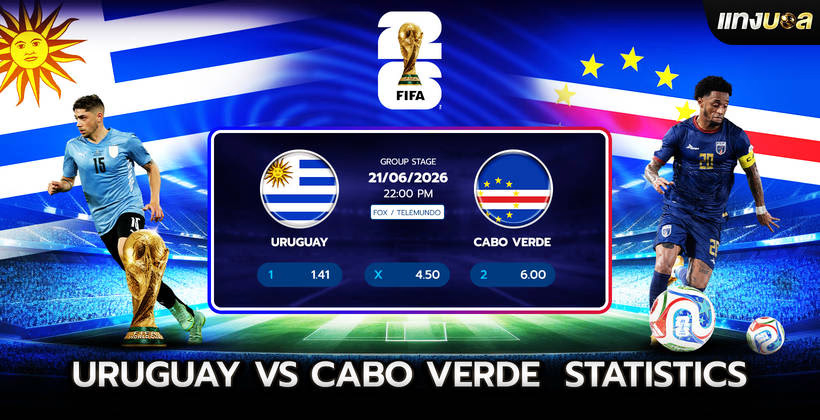
Uruguay's current World Cup standings and performance metrics are listed below.
- World Cup Group H Standings: Uruguay currently occupies fourth place in Group H of the 2026 FIFA World Cup standings, with 0 matches played, 0 wins, 0 draws, 0 losses, 0 goals scored, 0 goals conceded, and 0 points at the start of the group stage. Group H includes Spain, Cabo Verde, Saudi Arabia, and Uruguay.
- Points & Position Metrics: Uruguay’s position in the table reflects the official group list before any results are announced. Standings show Spain first, Cabo Verde second, Saudi Arabia third, and Uruguay fourth, all on 0 points before match action.
- Goals For/Against: Uruguay’s goal metrics stand at 0 goals for and 0 goals against in the group stage so far, as the team has yet to play any World Cup matches.
- Qualification Path Opportunities: Group H’s format places emphasis on points total across three matches, the top two teams automatically advance to the Round of 32, while the best third‑placed side can also progress under expanded 48‑team rules. Uruguay’s positioning and performance in upcoming matches will determine its advancement prospects.
- Historical Qualification Performance: Uruguay qualified for the 2026 World Cup by finishing fourth in the CONMEBOL qualifying standings, demonstrating effective performance against South American competition leading into the finals.
How has Uruguay's National Football Team Performed Recently?
Uruguay's national football team has performed over the past 12–24 months, showing a mix of results. The team had strong performances in the Copa América, finishing third with wins against Panama and Bolivia, but struggled with inconsistency in tight matches, including a 5‑1 loss to the U.S. in 2025. Recent fixtures have included a few wins, several draws, and a couple of losses, with notable defensive issues arising in friendlies. Injuries to key players, such as Giorgian de Arrascaeta’s collarbone fracture, have affected squad depth, particularly in midfield. Despite internal tensions under coach Marcelo Bielsa, his leadership has provided tactical continuity. Uruguay's schedule, including high‑profile friendlies and qualifiers, has influenced performance, preparing the team for the upcoming World Cup.
What Tactical Formations are Uruguay Expected to use in this Match?
Tactical formations that Uruguay expected to use in this match are listed below.
- 4‑3‑3 Formation: Uruguay is expected to use a 4‑3‑3 shape with four defenders, three midfielders, and three forwards, offering balance between defense and attack. The full‑backs provide width while the midfield trio supports both build‑up play and transitions. The front three (wingers and central striker) work to stretch the opposition’s defensive block and exploit spaces on the flanks and between lines. The 4‑3‑3 has been consistently used in recent tactical lineups during the World Cup build‑up.
- 4‑2‑3‑1 Variation: Uruguay can shift to a 4‑2‑3‑1 when greater midfield solidity and creative support behind the striker are required. Two deeper midfielders (holding roles) shield the defense while a line of three attacking midfielders offers creativity and penetration through the middle. This setup helps control possession and support the lone forward in more congested spaces.
- 4‑1‑4‑1 Structure: Uruguay may adopt a 4‑1‑4‑1 with a dedicated defensive pivot in midfield isolating the opposition’s attack before rising into a 4‑3‑3 shape in possession. The single pivot (defensive midfielder) provides extra cover, while the wider midfield quartet transitions quickly into attack, enabling effective press resistance and counter‑pressing across the field.
- Fluid High Press Setup: Marcelo Bielsa, Uruguay’s coach, Uruguay’s system includes fluid movement and high press across all lines. Full‑backs push high to compress play, midfielders anticipate ball recoveries, and attackers maintain pressure on defenders, influencing formation shifts mid‑match while maintaining structure.
How does Uruguay's Attacking Pace Affect Cabo Verde's Defensive Strategy?
Uruguay's attacking pace affects Cabo Verde's defensive strategy by forcing them to adopt a more conservative and reactive approach. The rapid transitions and quick counter-attacks from Darwin Núñez and Luis Suárez push Cabo Verde's defense to drop deeper, maintaining a compact shape to avoid being caught off guard. The limits Cabo Verde's ability to press high or maintain offensive pressure, as their defensive block stretches and becomes more susceptible to fast breaks. The need to counter Uruguay’s pace often leads to mistakes or gaps in their defensive setup, which Uruguay can exploit with precise passes or rapid forward runs.
Is Uruguay's Passing Game Effective Against Cabo Verde's Defensive Block?
Yes, Uruguay's passing game is effective against Cabo Verde's defensive block. Uruguay has a well-structured midfield with players like Federico Valverde and Giorgian de Arrascaeta, who excel in breaking down opposition defenses with precise passes and vision. Their ability to transition from defense to attack fast and accurately allows Uruguay to bypass compact defensive setups, such as Cabo Verde’s. The attacking runs from players like Darwin Núñez and Luis Suárez stretch defenses, creating space for Uruguay to exploit with quick passes. Cabo Verde’s defense, while resilient, faces challenges in dealing with Uruguay's movement and technical ability in midfield, which often leads to successful breaking of defensive lines.
Which Players are Currently on Uruguay's National Team Roster?
Players currently on Uruguay's national team roster are listed below.
- Sergio Rochet (Internacional, Goalkeeper): Rochet is Uruguay's primary goalkeeper, recognized for his excellent shot-stopping ability and leadership on the field. His strong reflexes and consistency make him a key figure in the national team’s defense.
- Fernando Muslera (Estudiantes de La Plata, Goalkeeper): Muslera has been Uruguay’s long-time No. 1 goalkeeper. He brings valuable experience and calmness under pressure, providing stability and leadership in achieving goals.
- Santiago Mele (Montevideo Wanderers, Goalkeeper): Mele is Uruguay’s backup goalkeeper, offering reliability and depth to the squad with his solid performances for club and country.
- Ronald Araujo (FC Barcelona, Defender): Araujo is a crucial center-back for Uruguay, known for his strength, aerial dominance, and tactical awareness. He is a rock at the back, regularly marking top strikers.
- José María Giménez (Atlético Madrid, Defender): Giménez is an experienced center-back and leader. He plays a key role in Uruguay's defensive setup, contributing in both defense and aerial duels.
- Sebastián Cáceres (America, Defender): Cáceres is a versatile central defender with strong positioning and physicality, adding depth to Uruguay’s defense.
- Mathías Olivera (Napoli, Defender): Olivera is a dynamic left-back, known for his pace and attacking contributions down the flank, providing balance between defense and attack.
- Guillermo Varela (Flamengo, Defender): Varela plays as a right-back and offers both defensive stability and attacking support with his pace and crossing ability.
- Matías Viña (Roma, Defender): Viña is an energetic left-back who brings both defensive reliability and offensive width to Uruguay's backline.
- Santiago Bueno (Girona, Defender): Bueno is a strong central defender, known for his leadership and physicality, contributing to Uruguay's defensive organization.
- José Luis Rodríguez (Vasco da Gama, Defender): Rodríguez is a versatile right-back, known for his speed and defensive acumen, contributing to Uruguay's well-organized defense.
- Federico Valverde (Real Madrid, Midfielder): Valverde is Uruguay’s engine in midfield. His work rate, technical ability, and box-to-box movement make him a vital player in both defensive and offensive roles.
- Giorgian de Arrascaeta (Flamengo, Midfielder): De Arrascaeta is an attacking midfielder with excellent vision and passing range. He is known for creating opportunities and contributing to goals from midfield.
- Facundo Pellistri (Manchester United, Midfielder): Pellistri is a dynamic winger known for his pace and dribbling ability, contributing to Uruguay’s offensive play with quick runs and crosses.
- Emiliano Martínez (Real Salt Lake, Midfielder): Martínez is a versatile midfielder known for his energy and ability to influence play in both attacking and defensive phases.
- Darwin Núñez (Liverpool, Forward): Núñez is Uruguay's main forward, renowned for his pace, physicality, and finishing ability. His goal-scoring contributions are vital to Uruguay's attacking threat.
- Luis Suárez (Grêmio, Forward): Suárez is one of Uruguay's all-time greats. As a prolific goal-scorer and attacking leader, he brings experience and clinical finishing.
- Edinson Cavani (Valencia, Forward): Cavani is a veteran forward known for his movement, aerial ability, and finishing. His leadership and experience make him a key player for Uruguay.
- Rodrigo Aguirre (Auckland City, Forward): Aguirre is a versatile forward who offers physicality and work rate, contributing to both the aerial and ground attack.