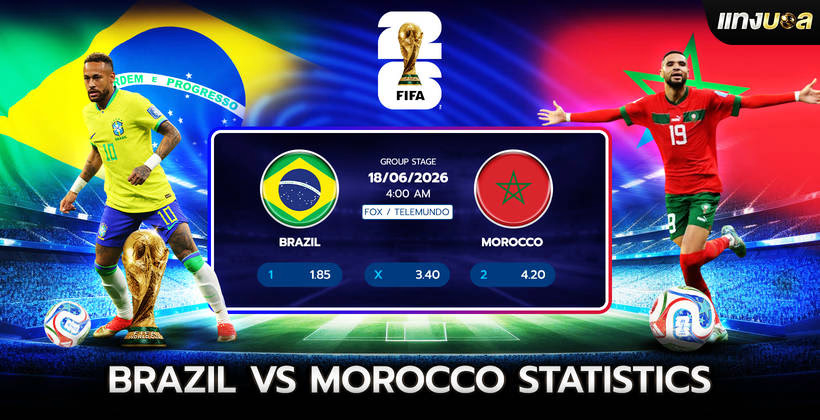
Brazil's current World Cup standings and performance metrics are listed below.
- Group position: Brazil sits in Group C alongside Morocco, Haiti, and Scotland after the FIFA World Cup 2026 final draw. Official group points remain at zero before kickoff, yet seeding and squad depth place Brazil near the top of pre-tournament projections.
- Recent form: Brazil posted a 3-1 win against Croatia, a 2-1 loss against France, a 1-0 win against Paraguay, and a 0-0 draw against Ecuador. Recent results show competitive form against strong opposition and a stable defensive floor.
- Attack profile: Brazil enters the World Cup year with Vinicius Junior, Rodrygo, Endrick, and Igor Thiago as notable attacking options. FIFA’s Brazil coverage points to a side built around pace, one-on-one quality, and central finishing support.
- Coaching factor: Carlo Ancelotti leads Brazil into the tournament after taking charge during the qualification cycle. Managerial change, squad rotation, and March friendlies serve as key performance markers ahead of Group C play.
How has Brazil's National Football Team Performed Recently?
Brazil’s national football team has produced a mixed yet competitive run across the last 12 to 24 months. FIFA’s World Cup coverage shows Brazil drew Ecuador 0-0 and beat Paraguay 1-0 in June 2025, then beat Croatia 3-1 before losing 2-1 against France in March 2026. A 3-3 draw against Spain in March 2024 added another result against elite opposition. Performance factors include the coaching shift to Carlo Ancelotti, who replaced Dorival Junior during the World Cup cycle, plus squad reshaping ahead of the tournament. FIFA’s March 2026 squad report noted Neymar’s omission, which points to a selection change and fitness management as part of preparation. The schedule difficulty stayed high, so Brazil’s recent record looks solid rather than dominant heading into Group C.
What Tactical Formations are Brazil expected to use in this Match?
The tactical formations Brazil is expected to use in this match are listed below.
- Base 4-3-3: Brazil is expected to start from a 4 3 3 shape built around wide speed and central support. Vinicius Junior and Rodrygo operate on the flanks to stretch defenses and create space inside.
- Control 4-2-3-1: Brazil can shift into a 4 2 3 1 during longer possession phases. A double pivot adds defensive balance and supports structured buildup through central areas.
- High pressing front: Brazil’s forward line applies pressure immediately after losing possession. Early pressing forces errors and keeps the ball in advanced areas.
- Compact 4-4-2 block: Brazil may drop into a 4 4 2 defensive shape during opponent buildup. Midfield lines stay tight to reduce passing lanes and protect central zones.
- Flexible 3-2 buildup: Brazil can form a 3 2 structure during buildup with one full back moving inside. That adjustment improves ball progression and creates overloads in midfield.
How Many World Cup Titles Has Brazil Won?
Brazil has won five FIFA World Cup titles, which remains the highest total in the history of the men’s tournament. FIFA’s historical World Cup profile for Brazil lists championship wins in 1958, 1962, 1970, 1994, and 2002, placing the Seleção alone at the top of the all-time honors table. That record gives Brazil unusual weight in any tournament preview because title expectations follow the team into every edition. FIFA’s Brazil team profile for 2026 links the current squad to that legacy and frames Brazil as a side measured against championship standards rather than simple qualification goals. Historical titles do not decide the June 2026 match against Morocco, yet they shape public perception, media pressure, and betting interest around the fixture. Brazil’s title count remains a key statistical marker in any World Cup discussion.
Is Brazil Expected to Dominate Possession Against Morocco?
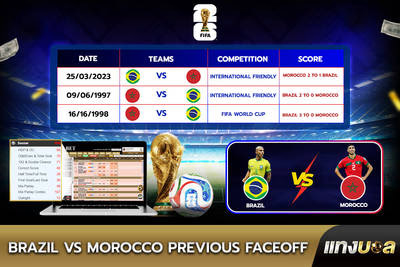
Yes, Brazil is expected to dominate possession against Morocco. FIFA’s Brazil coverage under Carlo Ancelotti points to a team built around midfield command, wide progression, and repeated final third entries through players like Vinicius Junior and Rodrygo. Morocco enters the tournament from a very different tactical base. FIFA’s March 2026 report on Morocco under Mohamed Ouahbi highlights compact defending, organized shape, and direct transitions after ball recovery. That contrast makes Brazil the likelier side to hold longer spells of possession in Group C. Recent head-to-head context still warns against overconfidence. Morocco beat Brazil 2 to 1 in March 2023, which showed that disciplined defending and efficient counterattacks can punish Brazil even without territorial control. Possession should lean toward Brazil, yet the match threat remains balanced enough to keep the game competitive.
Which Players are Currently on Brazil's National Team Roster?
The players who are currently on Brazil's national team roster are listed below.
- Alisson Becker (Liverpool, Goalkeeper): Becker remains a first-choice goalkeeper in Brazil’s current squad. Brazil's match records highlight strong save consistency and reliable distribution during high-level fixtures.
- Ederson Moraes (Manchester City, Goalkeeper): Moraes serves as a ball-playing goalkeeper with an elite passing range. Club and international data show frequent involvement in the buildup and transition phases.
- Marquinhos (Paris Saint-Germain, Center back): Marquinhos leads the defensive line with strong positioning and leadership. International appearances reflect consistent selection in major competitions.
- Éder Militão (Real Madrid, Center back): Militão offers pace and recovery strength in central defense. Match data shows regular use in high-line defensive systems.
- Léo Ortiz (Flamengo, Center back): Ortiz provides composure in defensive buildup. Domestic and international matches highlight controlled passing under pressure.
- Alex Sandro (Flamengo, Full back): Sandro contributes experience on the left flank. Defensive metrics show steady coverage and positional awareness.
- Vanderson (Monaco, Full back): Vanderson adds attacking width from the right side. Performance data highlights forward runs and crossing support.
- Casemiro (Manchester United, Defensive midfielder): Casemiro anchors midfield structure with tackling and interception strength. Match records show consistent ball recovery and defensive shielding.
- Bruno Guimarães (Newcastle United, Central midfielder): Guimarães operates as a creative link in midfield. Passing statistics reflect high involvement in progression and distribution.
- Lucas Paquetá (West Ham United, Attacking midfielder): Paquetá functions as an advanced playmaker. Match contributions include key passes and final third movement.
- Joelinton (Newcastle United, Central midfielder): Joelinton adds physical presence in midfield battles. Performance data shows strong pressing and ball recovery.
- Andrey Santos (Chelsea, Central midfielder): Santos brings energy and forward movement into midfield rotations. Development reports highlight growing involvement in senior matches.
- Vinícius Júnior (Real Madrid, Winger): Vinícius drives attacking play through pace and dribbling. Match data shows a high chance of creation from wide areas.
- Rodrygo (Real Madrid, Winger): Rodrygo contributes versatility across attacking positions. Performance records highlight finishing ability and movement.
- Endrick (Real Madrid, Forward): Endrick provides a central goal-scoring option. Early international appearances show strong finishing potential.
- Matheus Cunha (Wolverhampton Wanderers, Forward): Cunha supports link-up play in attack. Match data reflects pressing activity and positional flexibility.
- Igor Thiago (Brentford, Forward): Thiago adds physical strength in the forward line. Performance metrics show aerial ability and hold-up play.