Switzerland's Current World Cup Standings and Performance Metrics are listed below.
- Group Position: Switzerland topped UEFA qualifying Group B with 6 matches played, 4 wins, 2 draws, 0 losses, 14 goals scored, 2 conceded, and a goal difference of +12, finishing with 14 points to secure direct qualification.
- FIFA Ranking: Switzerland entered 2026 ranked 18th in the FIFA rankings, reflecting steady upward momentum built on defensive solidity and structured transitions.
- World Cup Group B Position: Switzerland enters Group B as the clear favorite, with markets projecting a near-guaranteed route to the knockout stages, leaving Canada and Bosnia and Herzegovina competing for second place.
- Defensive Record: Switzerland conceded only 2 goals across 6 qualifying matches, recording a goal difference of +12, establishing one of the tightest defensive records in UEFA qualifying.
- Attacking Output: Switzerland's attacking threat was consistent throughout qualifying, with Nico Elvedi, Breel Embolo, and Dan Ndoye all contributing goals, including a dominant 3-0 win over Slovenia, where 2 goals came from set pieces.
- Tournament Pedigree: Switzerland has qualified for the World Cup since 2006, advancing to the knockout rounds in each of the last 3 editions, alongside back-to-back quarterfinal appearances at Euro 2020 and Euro 2024.
- Top Scorer: Breel Embolo leads Switzerland's scoring with 4 goals during qualifying, making him the primary attacking threat heading into the tournament.
How has Switzerland's National Football Team Performed Recently?
Switzerland's National Football Team recently form across the 2024 to 2026 window reflects steady consistency with selective setbacks. The squad topped UEFA Group G unbeaten with 14 points from 6 matches, scoring 14 goals and conceding only 2, including a 3-1 win over Serbia during World Cup qualifying. Across the last 5 matches, the Swiss recorded 1 win, 2 draws, and 1 loss, conceding 6 goals. The sharpest dip came in a March 2026 friendly against Germany, where Switzerland led 3-2 before losing 4-3. Xherdan Shaqiri's retirement after Euro 2024 thinned attacking depth, while Filip Ugrinić's injury withdrawal further tested squad resources. Murat Yakin has maintained tactical stability since 2021, with Switzerland entering 2026 ranked 18th in the FIFA rankings.
What Tactical Formations are Switzerland Expected to use in this Match?
Tactical formations that Switzerland expected to use in this match are listed below.
- 4-2-3-1 (Primary Formation): Yakin's primary system is a 4-2-3-1 built around Granit Xhaka as the controlling midfielder who sets the tempo, covers the ground from the lines, and pulls the strings from deep. Xhaka sits deep to control tempo, Embolo leads the press, and the wide players cause problems in transition, with Switzerland pressing high to force errors and dominate possession in the middle third.
- 3-4-3 (Flexible Alternative): Yakin deploys a flexible 3-4-3 formation that uses a solid defensive base with 3 center-backs, while wing-backs push high to provide width in attack, shifting shape depending on opposition and match situation. Granit Xhaka and Remo Freuler form a double pivot in midfield, controlling tempo and dropping deep to receive the ball for structured transitions.
- 3-4-2-1 (Defensive Variant): The Yakin-led side alternates to a 3-4-2-1 system depending on opposition, maintaining reputable midfield control with quick transitions into wide areas. The defensive variant prioritizes tactical discipline and defensive organization, with the team's weakness emerging in creative attacking play against deep-sitting defenses.
- Tactical Flexibility (General Approach): Switzerland switches formations based on different opponents, at times using a compact defensive setup and at other times pressing higher to control possession and tempo. Switzerland's attacking structure is built around pace on the flanks, physicality through the middle, and a midfield link that ties transitions together into consistently dangerous forward movements.
What is Switzerland's All Time World Cup Record?
Switzerland's all-time World Cup record stands at 14 wins, 8 draws, and 19 losses across 41 matches in 12 appearances, with a 34% win rate, 55 goals scored, and 73 conceded. Their best performances came in 1934, 1938, and 1954, reaching the quarterfinals on each occasion. The 1954 tournament stands out, as Switzerland hosted the competition and featured in the highest-scoring World Cup match ever played, a 7-5 quarterfinal defeat to Austria. In 2006, the Swiss became the only team eliminated from a World Cup without conceding a single goal during regulation time, exiting to Ukraine on penalties. In recent editions, Switzerland reached the Round of 16 in 3 straight World Cups, cementing a reputation as a consistent, structured side at the tournament level
Is Switzerland Considered the Favorite in This Match?
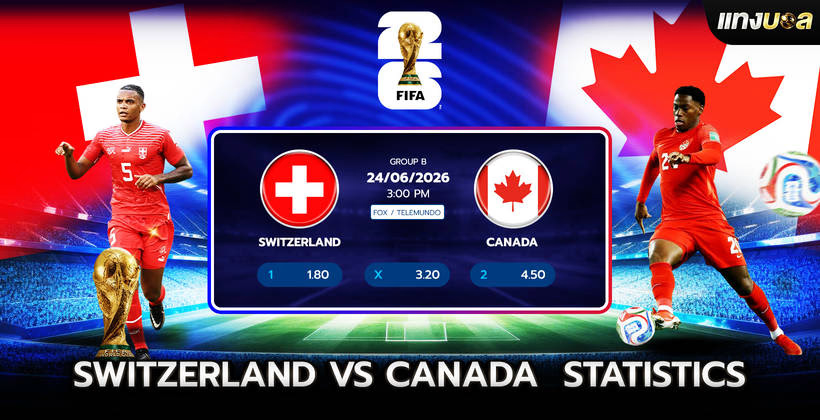
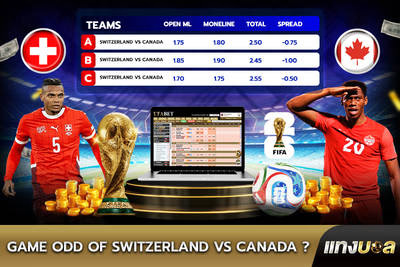
Yes, Switzerland is considered the favorite in this match. Sportsbook odds place Switzerland at -105, ahead of Canada at +260, with trader markets assigning the Swiss a 56.5% implied probability of winning. Switzerland topped their UEFA qualifying group unbeaten, finishing with 14 points from 6 matches, scoring 14 goals and conceding only 2. Canada has never advanced past the group stage in any prior World Cup appearance, with injury concerns surrounding Alphonso Davies and Stephen Eustáquio further weakening their prospects ahead of the June 24 fixture.
Which Players are Currently on Switzerland 's National Team Roster?
Players currently on Switzerland's National Team Roster are listed below.
- Gregor Kobel (Borussia Dortmund, Goalkeeper): Kobel serves as the first-choice goalkeeper, with distribution that supports Switzerland's build-up play from the back.
- Yvon Mvogo (Lorient, Goalkeeper): Mvogo fills the second-choice role, providing experienced backup between the posts.
- Marvin Keller (Young Boys, Goalkeeper): Keller rounds out the goalkeeping department as the third option in the squad.
- Manuel Akanji (Inter Milan, Center-Back): Akanji provides composure and defensive organization at the heart of Switzerland's backline.
- Nico Elvedi (Borussia Mönchengladbach, Center-Back): Elvedi partners Akanji to form a reliable and experienced defensive pairing.
- Ricardo Rodriguez (Real Betis, Left-Back): Rodriguez adds leadership and set-piece quality, bringing veteran presence to the defensive unit.
- Silvan Widmer (Mainz, Right-Back): Widmer provides energy and width on the right flank, contributing to Switzerland's attacking transitions.
- Aurèle Amenda (Eintracht Frankfurt, Center-Back): Amenda adds depth and physicality to the backline as one of the younger defensive options in the squad.
- Granit Xhaka (Sunderland, Central Midfielder): Xhaka serves as captain and Switzerland's most-capped player with 143 appearances, remaining the emotional and tactical leader of the midfield.
- Fabian Rieder (FC Augsburg, Central Midfielder): Rieder contributes creativity and chance creation, recording 8 chances created during qualifying.
- Johan Manzambi (SC Freiburg, Defensive Midfielder): Manzambi scored 2 goals during qualifying, operating centrally with strong duel-winning ability.
- Ardon Jashari (AC Milan, Defensive Midfielder): Jashari is among the most exciting young prospects in the squad at just 23 years old.
- Michel Aebischer (Pisa, Central Midfielder): Aebischer adds versatility and work rate across the central midfield positions.
- Breel Embolo (Rennes, Striker): Embolo leads the attack as Switzerland's top scorer during qualifying with 4 goals, combining physicality with proven goal-scoring ability at the tournament level.
- Dan Ndoye (Nottingham Forest, Winger): Ndoye provides pace and directness on the flank, registering 3 assists during qualifying.
- Ruben Vargas (Sevilla, Winger): Vargas contributed 3 assists during qualifying, offering creative output and width on the left side of attack.
- Noah Okafor (Leeds United, Forward): Okafor adds depth and versatility across the attacking line, providing an impactful option from the bench.