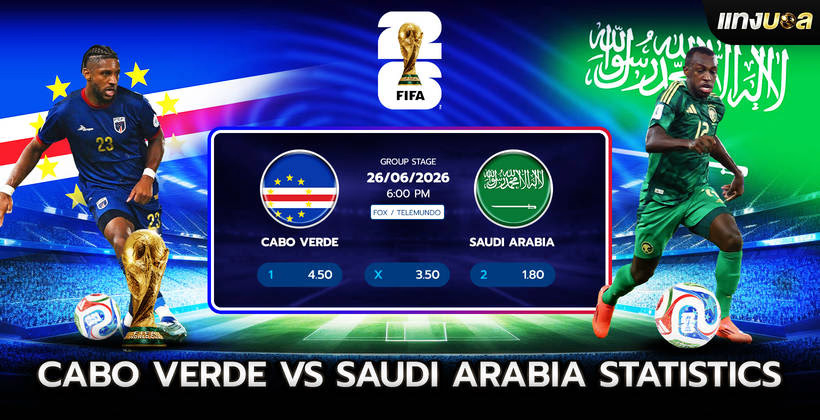
Cabo Verde's current World Cup standings and performance metrics are listed below.
- Group Position: Cabo Verde sits in Group H alongside Spain, Saudi Arabia, and Uruguay, marking the nation's first-ever FIFA World Cup appearance in the tournament's history.
- FIFA Ranking: Cabo Verde entered 2026 ranked 74th in the FIFA rankings, reflecting steady upward momentum built on consistent CAF qualifying performances and regional tournament results.
- World Cup Group H Position: Cabo Verde enters Group H as the fourth-ranked side, with markets reflecting the difficulty of progressing past Spain and Saudi Arabia in the group stage.
- Defensive Record: Cabo Verde conceded 6 goals across 8 CAF qualifying matches, recording a positive goal difference built on structured defensive organization and midfield compactness.
- Attacking Output: Cabo Verde's attacking threat remained consistent throughout qualifying, with Garry Rodrigues, Ryan Mendes, and Jamiro Monteiro contributing goals across multiple fixtures.
- Tournament Pedigree: Cabo Verde reached the Africa Cup of Nations quarterfinals in 2021 and 2023, demonstrating the ability to compete and progress at the continental tournament level.
- Top Scorer: Garry Rodrigues leads Cabo Verde's scoring record heading into the tournament, providing the primary wide attacking threat across the national team's transitional system.
How has Cabo Verde's National Football Team Performed Recently?
Cabo Verde's national football team's recent form across the 2025 to 2026 window reflects growing competitive consistency with strong qualifying results and credible friendly performances. The squad secured CAF qualification through disciplined defensive organization and counter-attacking efficiency, finishing the campaign with a positive goal difference across 8 matches. Across the last 5 matches, Cabo Verde recorded 2 wins, 2 draws, and 1 loss, demonstrating competitive resilience against African opposition of varying quality levels. The standout result came in the 1 to 0 win against Cameroon in November 2025, confirming the team's ability to secure points against physically imposing and technically superior opposition. Head coach Pedro Brito continues to implement a structured 4-2-3-1 system that prioritizes defensive compactness and rapid transitional play through wide attacking channels. Cabo Verde enters the 2026 World Cup as a historic first-time participant, ranked 74th in the FIFA rankings with genuine momentum from the qualifying campaign.
What Tactical Formations are Cabo Verde Expected to use in this Match?
Tactical formations that Cabo Verde is expected to use in this match are listed below.
- 4-2-3-1 (Primary Formation): Pedro Brito's primary system deploys a 4-2-3-1 built around a compact double pivot that protects the defensive structure while allowing wide players to drive forward in transition. Garry Rodrigues operates on the right flank, combining pace and directness to create attacking width against Saudi Arabia's defensive shape.
- 4-4-2 (Defensive Alternative): Cabo Verde deploys a 4-4-2 in matches where absorbing pressure and limiting central space becomes the tactical priority, dropping into a structured mid-block to frustrate attacking opponents. The flat midfield four restricts passing lanes through the center while maintaining two forward targets for direct transition play.
- 4-3-3 (Attacking Variant): Cabo Verde shifts to a 4-3-3 in fixtures where early attacking momentum is required, pushing wide forwards higher to press Saudi Arabia's defensive line and create space in behind. The front three relies on pace and directness, exploiting transition moments when Saudi Arabia's defensive shape stretches during attacking phases.
- Tactical Flexibility (Common Approach): Cabo Verde switches formations based on match context, pressing higher in the opening phases before settling into controlled defensive positioning. The team's attacking structure centers on wide channel exploitation, set-piece delivery, and disciplined defensive shape that limits high-volume scoring opportunities against technically superior opposition.
Which Cabo Verde Player is Most Likely to Receive a Yellow Card Against Saudi Arabia?
The Cabo Verde player most likely to receive a yellow card against Saudi Arabia is Steven Fortes. Fortes operates as a central defensive midfielder tasked with breaking up Saudi Arabia's possession sequences and protecting the defensive structure under sustained pressure. The role demands aggressive pressing, physical duels, and tactical fouling in dangerous transition areas, increasing yellow card exposure across 90 minutes. Fortes carries an established profile of combative midfield play built on high-intensity ball-winning rather than technical avoidance of contact situations. Saudi Arabia's midfield, anchored by Sami Al-Najei and Riyadh Sharahili, draws fouls through clever movement and quick combination play in tight central areas. A high-pressure fixture against technically superior opposition increases the frequency of defensive interventions from Fortes across halves. The yellow card risk reflects the tactical demands placed on Cabo Verde's defensive midfield rather than separate disciplinary inconsistency.
Does Cabo Verde Have a Weakness in Defending Wide Areas Against Saudi Arabia?
Yes, Cabo Verde has a weakness in defending wide areas against Saudi Arabia. The team's 4-2-3-1 structure relies heavily on the double pivot to cover central defensive spaces, leaving the full-back positions exposed during Saudi Arabia's wide attacking transitions. Saudi Arabia's wide players, including Firas Al-Buraikan and Salem Al-Dawsari, exploit space behind advancing full-backs with direct runs and quick combination play along the flanks. Cabo Verde's full-backs push forward during attacking phases, creating defensive gaps that Saudi Arabia's transitional speed targets consistently. The wide area vulnerability illustrates the clearest tactical exposure in Cabo Verde's defensive structure heading into the Group H fixture.
Which Players are Currently on Cabo Verde's National Team Roster?
The players currently on Cabo Verde's national team roster are listed below.
- Vozinha (Celta Vigo, Goalkeeper): Vozinha performs as the first-choice goalkeeper, bringing veteran international experience, strong shot-stopping ability, and leadership in organizing the defensive structure. Vozinha’s command of the penalty area stabilizes Cabo Verde’s backline.
- Bruno Varela (Vitória SC, Goalkeeper): Varela provides experienced backup goalkeeping from European football, offering composure, distribution quality, and reliable depth behind the starter.
- Marcio Rosa (Club TBD, Goalkeeper): Rosa completes the goalkeeping unit as a depth option, contributing squad coverage and developmental support within the national team setup.
- Roberto Lopes (Shamrock Rovers, Center-Back): Lopes anchors the defense with leadership, aerial dominance, and consistent international experience, providing tactical discipline in central defense.
- Stopira (Ludogorets, Center-Back): Stopira brings extensive international experience and positional intelligence, ensuring defensive stability and composure under pressure.
- Logan Costa (Villarreal, Center-Back): Costa adds top-level European defensive quality, combining strength, ball progression, and recovery speed in central defense.
- Steven Fortes (Gil Vicente, Center-Back): Fortes provides physical presence, aggressive defending, and reliability in duels across the backline.
- Diney (Boavista, Right-Back): Diney contributes defensive structure and overlapping runs, supporting both defensive stability and attacking width.
- Filipe Moreira (Famalicão, Left-Back): Moreira provides defensive coverage and forward support on the left flank, maintaining balance in transitions.
- Élton Monteiro (Yverdon Sport, Center-Back): Monteiro adds European experience and defensive versatility, strengthening depth in central defense.
- Jamiro Monteiro (Philadelphia Union, Central Midfielder): Monteiro delivers creativity, progressive carrying, and attacking influence from midfield, linking defensive and attacking phases.
- Kenny Rocha Santos (Belenenses, Central Midfielder): Rocha Santos brings energy, physicality, and disciplined midfield coverage in central areas.
- Patrick Andrade (Qarabağ FK, Central Midfielder): Andrade contributes defensive stability and European experience, strengthening midfield control.
- Telmo Arcanjo (Vitória SC, Attacking Midfielder/Winger): Arcanjo adds creativity, dribbling ability, and attacking unpredictability from advanced positions.
- Willy Semedo (Vitória SC, Winger): Semedo provides pace, pressing intensity, and wide attacking support in transition play.
- Garry Rodrigues (Al-Ettifaq, Winger): Rodrigues serves as a key attacking threat with pace, dribbling, and direct goal contribution from wide areas.
- Ryan Mendes (Nantes, Winger): Mendes adds experience, width, and attacking consistency from the left flank.
- Lisandro Semedo (Paços de Ferreira, Winger): Semedo provides direct dribbling and attacking penetration from wide positions.
- Jovane Cabral (Olympiacos, Forward): Cabral brings flair, creativity, and attacking versatility across forward positions.
- Gilson Tavares (Marítimo, Forward): Tavares offers physicality, pressing, and central attacking support with a strong work rate.
- Djaniny (Al-Fateh, Striker): Djaniny leads the attack with experience, finishing ability, and a proven international goal-scoring record.
- Dailon Livramento (Hellas Verona, Striker): Livramento adds youthful attacking energy, movement, and finishing potential as a modern forward option.