Austria vs Jordan Statistics

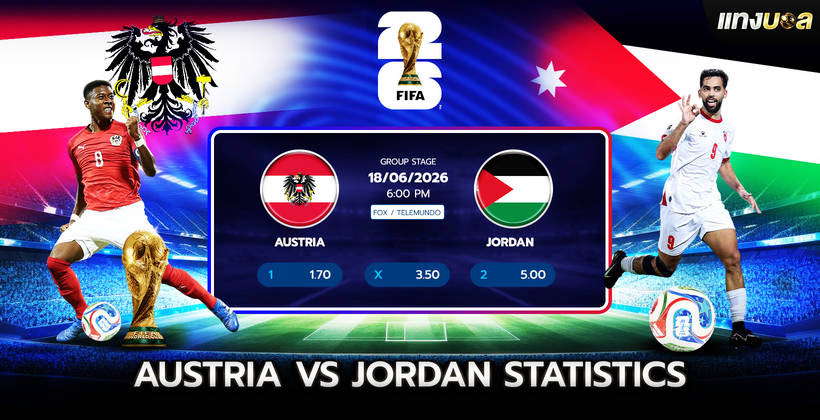
Austria vs Jordan statistics in Group J highlight a clash between European tactical discipline and Middle Eastern attacking flair. Austria enters the match with consistent results in regional qualifiers, including victories over Sweden and Azerbaijan. Jordan arrives with momentum after strong performances in the Asian Cup, where the squad reached the final rounds. Austria’s technical proficiency in midfield, led by Marcel Sabitzer and Konrad Laimer, provides a structured approach to ball progression. Jordan’s offensive strategy relies on the pace and individual skill of Musa Al-Tamari to exploit defensive gaps. Austria and Jordan occupy different positions in the global rankings, and the match remains competitive due to contrasting styles of play. Austria vs Jordan represents a pivotal fixture for the two nations seeking to advance from a group containing Argentina and Algeria.

Austria vs Jordan statistics
Group: Group J
Date and Time of Match: Thursday, June 18, 2026, at 6:00 PM ET (local Miami time)
Location: Hard Rock Stadium in Miami, USA
Coverage: FOX / Telemundo

Austria vs Jordan Statistics

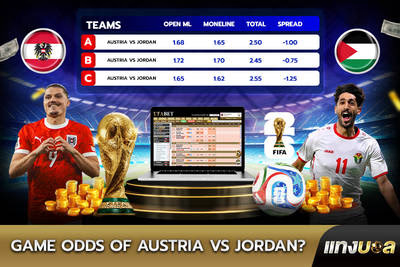
Game Odds of Austria vs Jordan?

The game odds of Austria vs Jordan are shown in the table below.

Teams Open ML Moneyline Total Spread
Austria vs Jordan (A)1.681.652.50-1.00
Austria vs Jordan (B)1.721.702.45-0.75
Austria vs Jordan (C)1.651.622.55-1.25

Game odds of Austria vs Jordan reflect the probability of success based on historical data, squad depth, and recent tournament form. Austria carries the favorite status due to a high ranking and experience in elite European competitions. Jordan offers higher returns for bettors as the underdog, reflecting the challenge of facing a top-tier UEFA representative. Market fluctuations occur based on team news, injury reports, and betting volume across major sportsbooks. Total goals projections suggest a moderate scoring game, while spread values indicate a clear expected margin for the European side. Evaluation of the figures assists in identifying value within the Austria vs Jordan market.

Game Odds of  Austria vs Jordan?

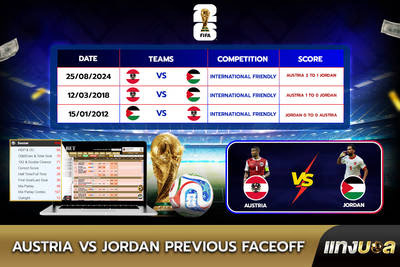
Austria vs Jordan Previous Faceoff

The Austria vs Jordan previous faceoff is shown in the table below.

Date Teams Competition Score
August 25, 2024Austria vs JordanInternational FriendlyAustria 2 to 1 Jordan
March 12, 2018Austria vs JordanInternational FriendlyAustria 1 to 0 Jordan
January 15, 2012Jordan vs AustriaInternational FriendlyJordan 0 to 0 Austria

Recorded results of Austria vs Jordan across previous encounters show a trend of narrow scorelines and defensive focus. Austria won the most recent meeting in 2024 by utilizing superior physical conditioning in the final stages of the match. The 2018 fixture resulted in a slim victory for the European side, where a single goal decided the outcome in a low-scoring affair. A scoreless draw in 2012 demonstrates Jordan’s capability to remain organized and resist high pressure from European opponents. History suggests that matches between the two nations are rarely high scoring due to tactical caution from the two managers. The historical data points remain essential for analyzing the previous faceoff results.

Austria  vs Jordan Previous Faceoff

Last 5 Games from Austria

The last 5 games from Austria are shown in the table below.

Date Team A Score Team B Competition Type
March 26, 2026Austria2 to 0TurkeyFriendly
March 22, 2026Slovakia0 to 2AustriaFriendly
November 21, 2025Austria2 to 0GermanyFriendly
November 16, 2025Estonia0 to 2AustriaEuro Qualifier
October 16, 2025Azerbaijan0 to 1AustriaEuro Qualifier

Austria's recent results demonstrate a period of high defensive efficiency and consistent winning form. A 2 to 0 victory against Turkey on March 26, 2026, showcases the ability to control matches against competitive rivals. A 2 to 0 away win over Slovakia on March 22, 2026, confirms the squad's proficiency in transition play. The 2 to 0 win against Germany on November 21, 2025, serves as a significant statement of intent regarding their tactical level. Consecutive clean sheets in European qualifiers against Estonia and Azerbaijan highlight a disciplined backline that remains difficult to breach. The outcomes reflect a cohesive unit prepared for the high intensity of the last 5 games.

Last 5 Games from Jordan

The last 5 games from Jordan are shown in the table below.

Date Team A Score Team B Competition Type
March 26, 2026Jordan7 to 0PakistanWorld Cup Qualifier
March 21, 2026Pakistan0 to 3JordanWorld Cup Qualifier
February 10, 2026Qatar3 to 1JordanAsian Cup Final
February 6, 2026Jordan2 to 0South KoreaAsian Cup Semi-Final
February 2, 2026Tajikistan0 to 1JordanAsian Cup Quarter-Final

Jordan's recent results highlight an impressive run in continental competition, followed by dominant displays in qualifiers. A 7 to 0 win against Pakistan on March 26, 2026, proves the clinical nature of the forward line. The 3 to 0 victory on March 21, 2026, reinforces the talent gap between Jordan and lower-ranked regional opponents. Reaching the Asian Cup final despite a 3 to 1 loss to Qatar indicates a historic achievement for the national program. A 2 to 0 victory over South Korea on February 6, 2026, serves as a landmark result that gained global attention for the team's tactical execution. Jordan maintains a high level of confidence, as seen in the last 5 games.

Group J Current Standing and Score Board

Group J's current standing and scoreboard are shown in the table below.

Team Wins Loss Draw Last Game
Argentina201Argentina 3 to 0 Algeria
Austria111Austria 1 to 1 Jordan
Jordan111Austria 1 to 1 Jordan
Algeria021Argentina 3 to 0 Algeria

Group J standings place Argentina at the top following a dominant 3 to 0 victory over Algeria that secured seven points. Austria holds second place based on goal difference after a competitive draw against Jordan in their most recent fixture. Jordan shares an identical record with Austria, leaving the race for the second qualification spot highly contested. Algeria sits at the bottom of the table with one point earned from a draw in the opening rounds. The group dynamic remains volatile as match outcomes impact the final ranking order. Performance in the fixtures dictates the momentum for teams in Group J.

Current World Cup Standing Summary

The current World Cup standing summary is shown in the table below.

Team Rank Win Draw Loss Goal Scored Goals Conceded Goal Difference Home Statistics Away Statistics Clean Sheet
Argentina121071+61W 1D 0L1W 0D 0L2
Austria211143+11W 0D 1L0W 1D 0L1
Jordan31113301W 0D 1L0W 1D 0L1
Algeria401218-70W 1D 0L0W 0D 1L0

The World Cup standing summary outlines performance across Argentina, Austria, Jordan, and Algeria through match results and scoring data. Argentina leads the group with strong attacking output and a high positive goal difference supported by consistent results across fixtures. Austria holds second position through balanced scoring and controlled defensive play, reflected in a positive goal difference. Jordan records mixed outcomes with an even goal margin, which keeps the squad in contention for advancement. Algeria remains without a win while conceding a high volume of goals, which impacts their ranking position. Home and away performance patterns provide further insight into the teams' defensive strength and consistency, influencing their World Cup standing in the group stage.

What is the Schedule of the World Cup for this Week

The schedule of the World Cup for this week is shown in the table below.

Match Date Time Location Group
Argentina vs AlgeriaJune 17, 20263:00 PMMetLife StadiumGroup J
Austria vs JordanJune 18, 20266:00 PMHard Rock StadiumGroup J
England vs ChileJune 18, 20269:00 PMRose BowlGroup B
France vs AustraliaJune 19, 20264:00 PMLevi’s StadiumGroup C
Japan vs SwedenJune 20, 20267:00 PMBMO FieldGroup D
Brazil vs SerbiaJune 21, 20268:00 PMAT&T StadiumGroup G

The World Cup schedule for this week outlines important fixtures that influence group rankings and competitive direction across multiple groups. Argentina vs Algeria represents a critical Group J match that affects the top position in the standings. Austria vs Jordan determines momentum within Group J, where point distribution impacts advancement scenarios. France vs Australia presents a tactical contest between the defending champions and a disciplined AFC side. Brazil vs Serbia highlights a high-intensity matchup that influences Group G progression. Japan vs Sweden reflects a competitive Group D fixture where tactical efficiency plays a key role. Match timing and venue location affect preparation, travel demands, and crowd influence, while fixture sequencing in the schedules of the World Cup defines performance consistency across teams.

How to Get the Latest Standings of the World Cup?

To get the latest standings of the World Cup, follow the six steps listed below.

  1. Access the UFABET website. Visit the official UFABET website using a secure internet connection on a desktop or mobile device.
  2. Navigate to the football section. Select the football category from the main sports menu to view tournament listings.
  3. Find the World Cup standings page. Locate the World Cup tab within the competition list to access group data.
  4. Examine group tables. Review the ranking tables to see updated points, wins, losses, and goal statistics.
  5. Review recent match results. Check the outcomes of the latest fixtures to understand recent shifts in the standings.
  6. Follow live standings updates. Observe real-time adjustments during active matches to track the latest World Cup standings.

How do you bet on UFABET Using Austria vs Jordan Statistics?

Bet on UFABET using the Austria vs Jordan statistics by following the six steps listed below.

  1. Register a UFABET account. Complete the registration form with accurate details to gain access to the betting interface.
  2. Add funds to the account. Deposit a balance using one of the secure payment methods (bank transfer or e-wallet).
  3. Access the football betting menu. Find the Austria vs Jordan match under the World Cup section of the sportsbook.
  4. Review Austria vs Jordan statistics. Analyze the recent form, head-to-head records, and scoring averages of both nations.
  5. Select a betting option. Choose a market such as the match winner, total goals, or Asian handicap based on the data.
  6. Place and confirm the bet. Enter the stake amount and finalize the ticket to engage in football betting.

What are Austria's Current World Cup Standings and Performance Metrics?

Austria’s current World Cup standings and performance metrics are listed below.

  • Group Position: Austria occupies the second place in Group J behind Argentina. The standing keeps the team in a qualification position for the knockout stages.
  • Match Results Record: Austria records one win, one draw, and one loss in the group phase. The squad demonstrates resilience against high-level opponents.
  • Goals Scored: Austria produces four goals through clinical finishing and set-piece execution. Attackers utilize high pressing to create chances in the final third.
  • Goals Conceded: Austria allows three goals against their defensive block across the group stage. Defensive organization remains the primary focus during transition moments.
  • Goal Difference: Austria maintains a positive goal difference of plus one. The margin provides a slight advantage over Jordan in the group rankings.
  • Points Accumulation: Austria collects four points from a possible nine available in the first three games. Total points reflect a competitive level consistent with their European ranking.
  • Clean Sheet Record: Austria secures one clean sheet during their victory against Algeria. Communication between the goalkeeper and defenders remains high.
  • Form and Momentum: Austria enters the upcoming match with stable form after a hard-fought draw. Consistency in the World Cup standings remains a primary objective.

How has Austria's National Football Team Performed Recently?

Austria’s national football team performed with high technical discipline and tactical cohesion throughout the recent Euro qualification and international friendlies leading into the tournament. Austria secured significant victories against established European nations, which demonstrated a high pressing system and efficient ball recovery. The squad maintained defensive stability while integrating younger talents into the core rotation to ensure long-term consistency. Recent match data shows a high success rate in vertical passing and zone occupation during the buildup phase. The coaching staff implemented a flexible structure that adapts to various opposition styles, resulting in a low loss margin across the last twelve months. Performance metrics indicate strong aerial dominance and successful set-piece execution in critical match moments. Austria enters the Group J fixtures with physical readiness and a clear tactical identity focused on collective pressing. The national team shows resilience in away fixtures by maintaining a high percentage of possession under pressure. The level of preparation contributes to their current World Cup standing.

What Tactical Formations are Austria Expected to use in this Match?

The tactical formations that Austria expected to use in this match are listed below.

  • 4-2-3-1 Formation: Austria utilizes a double pivot in midfield to provide defensive cover and control the match tempo. This structure allows the attacking midfielders to find pockets of space between the opposition lines.
  • 4-4-2 Diamond: Austria employs a narrow midfield diamond to overload the central areas of the pitch. The system relies on overlapping fullbacks to provide the necessary width for offensive crosses.
  • 4-3-3 Attacking Shape: Austria shifts to three forwards to apply maximum pressure on the opponent's backline. High wingers stretch the defense while a central striker targets long balls.
  • 5-3-2 Defensive Structure: Austria adopts a five-man defense when protecting a lead or facing elite offensive threats. The formation prioritizes compactness and utilizes quick wingbacks for counterattacking transitions.
  • High Pressing Variant: Austria implements a coordinated press to force turnovers deep in the opposition half. Players close down passing lanes to regain possession quickly.
  • Zonal Marking System: Austria organizes the defense based on specific zones rather than individual man-marking. This approach maintains the team's shape during set pieces and sustained pressure.

How does Austria Transition Quickly from Defense to Attack?

Austria transitions quickly from defense to attack by utilizing a high-intensity counterpressing system led by Konrad Laimer and Nicolas Seiwald that focuses on immediate ball recovery. The midfield duo initiates rapid vertical movements once possession is regained in the middle third. Tactical structures prioritize short explosive passing sequences to bypass the opposition's first line of pressure. Wingers stay high and wide to provide immediate outlets for long-range distribution from central defenders like David Alaba. Coordinated runs into the channels force opposing backlines to retreat while creating space for late-arriving midfielders. Automated patterns of play ensure every squad member knows their specific role during the first five seconds of a turnover. Physical conditioning allows the team to maintain a high-tempo style throughout both halves of the match. Statistical data confirms that most goal-scoring opportunities arise from rapid offensive shifts. Technical drills focus on improving the efficiency of each individual during a transition from defense to attack.

Is Austria Likely to Score Through Open Play?

Yes, Austria is likely to score through open play as Michael Gregoritsch and Christoph Baumgartner lead the attack. Technical patterns in the final third favor rapid ball movement between midfield and the forward line. Strikers utilize the space created by high wingers to target the goal area. Vertical passing strategies dismantle organized blocks by finding players in half spaces. Possession statistics indicate a preference for fluid attacking sequences over stationary play. High-intensity pressing forces turnovers that lead to immediate shooting chances. Tactical systems prioritize low crosses from the flanks to create high probability scoring events. Coordinated movements between the front three ensure constant pressure on the backline. Reliable scoring metrics highlight the team's efficiency during open play.

Which Players are Currently on Austria's National Team Roster?

The players who are currently on Austria’s national team roster are listed below.

  • Heinz Lindner (FC Sion, Goalkeeper): Lindner provides veteran leadership and exceptional shot-stopping abilities for the national team.
  • Alexander Schlager (RB Salzburg, Goalkeeper): Schlager offers strong reflexes and excellent ball distribution from the backline.
  • David Alaba (Real Madrid, Defender): Alaba acts as the captain and primary organizer of the defensive unit with elite technical skill.
  • Kevin Danso (Lens, Defender): Danso brings physical power and aerial dominance to the heart of the central defense.
  • Stefan Posch (Bologna, Defender): Posch provides versatility by playing as both a central defender and a right back effectively.
  • Maximilian Wöber (Leeds United, Defender): Wöber is a left-footed defender who offers balance and proficient playmaking from deep positions.
  • Philipp Lienhart (Freiburg, Defender): Lienhart focuses on positional awareness and intercepting through balls during intense pressure.
  • Phillipp Mwene (Mainz, Defender): Mwene excels in the wingback role with his high work rate and crossing ability on the flanks.
  • Konrad Laimer (Bayern Munich, Midfielder): Laimer is known for his relentless pressing and energy in the central midfield engine.
  • Marcel Sabitzer (Borussia Dortmund, Midfielder): Sabitzer dictates the tempo of the game with his superior passing range and vision.
  • Xaver Schlager (RB Leipzig, Midfielder): Schlager provides defensive stability and technical proficiency in the middle third of the pitch.
  • Nicolas Seiwald (RB Leipzig, Midfielder): Seiwald offers youthful energy and intelligent movement in the midfield defensive pivot.
  • Christoph Baumgartner (RB Leipzig, Midfielder): Baumgartner operates as an advanced playmaker with a knack for scoring crucial goals.
  • Florian Kainz (FC Köln, Midfielder): Kainz provides creativity and set-piece expertise from the wide positions on the field.
  • Romano Schmid (Werder Bremen, Midfielder): Schmid utilizes his low center of gravity and dribbling skills to beat defenders in tight spaces.
  • Michael Gregoritsch (Freiburg, Forward): Gregoritsch serves as the focal point of the attack with his height and physical strength.
  • Marko Arnautovic (Inter Milan, Forward): Arnautovic brings immense experience and technical flair to the forward line in major tournaments.
  • Patrick Wimmer (Wolfsburg, Forward): Wimmer provides pace and directness on the wings to take on defenders one-on-one.
  • Manprit Sarkaria (Sturm Graz, Forward): Sarkaria offers versatility in the attacking third with his ability to play multiple offensive roles.
  • Junior Adamu (Freiburg, Forward): Adamu represents the future of the attack with his speed and movement behind the backline.

What are Jordan's Current World Cup Standings and Performance Metrics?

Jordan's current World Cup standings and performance metrics are listed below.

  • Group Position: Jordan occupies the third position in Group J after three matches played. The ranking keeps the team within reach of a qualification spot.
  • Match Results Record: Jordan achieves a record of one win, one draw, and one loss in the tournament. The team demonstrates significant improvement in its competitive level.
  • Goals Scored: Jordan nets three goals through rapid counterattacks and individual brilliance in the final third. Scoring efforts depend on high-speed transitions.
  • Goals Conceded: Jordan allows three goals against their defensive block across the group stage. Most goals resulted from set-piece situations against taller opponents.
  • Goal Difference: Jordan maintains a goal difference of zero as the group stage progresses. This neutral standing makes every upcoming match critical for their ranking.
  • Points Accumulation: Jordan earns four points, matching the total of the second-placed Austrian team. Points were secured through a win over Algeria and a draw.
  • Clean Sheet Record: Jordan records one clean sheet in their opening victory of the tournament. Defensive organization limited the opponent's shots on target.
  • Form and Momentum: Jordan shows positive momentum after surprising critics with their tactical discipline and resilience. The team remains a dangerous underdog in the World Cup standings.

What are Jordan’s Main Attacking Threats in this Fixture?

Jordan’s main attacking threats in this fixture are listed below.

  • Rapid Transitional Speed: Jordan utilizes explosive pace to move from a defensive block into the final third within seconds. Forwards sprint into open channels the moment possession is regained in the middle area. Patterned movements exploit high defensive lines held by European opponents like Austria.
  • Individual Technical Dribbling: Elite ball control allows Jordanian attackers to navigate through tight defensive structures during one-on-one encounters. Players isolate fullbacks to create shooting angles or low crossing opportunities. Success in duels forces the opposition to commit extra defenders to wide zones.
  • Strategic Set Piece Execution: Physical height and organized movement during corner kicks provide reliable scoring chances throughout the ninety minutes. Specialized routines target the near post to catch goalkeepers out of position. Height advantages in the central area facilitate headed goals from deep free kick deliveries.
  • Tactical Verticality: The system prioritizes direct passing into the path of runners instead of slow sideways circulation. Vertical balls bypass the midfield line to reach the strikers immediately. Precise directness limits the time available for the Austrian defense to reorganize after a turnover.
  • Overloading Wide Areas: Wingbacks advance rapidly to create numerical superiorities against isolated defenders on the flanks. Overlapping runs distract the backline while central attackers find space inside the box. Constant width forces the defense to stretch, creating gaps in the middle of the attacking threats.

Where have Austria and Jordan Played Most Recently?

Austria and Jordan played most recently in major international venues across Europe and North America during the current World Cup cycle. Austria conducted their preparation matches in Vienna at the Ernst Happel Stadion to benefit from home crowd support. Jordan participated in high-level friendlies in Doha and Amman to acclimatize to different environmental conditions prior to the tournament. Austria and Jordan faced competitive rivals in the locations to refine their tactical systems and evaluate squad fitness. Recent matches in Philadelphia and Miami provided the teams with experience on the specific grass surfaces used for the final group stage. Match data from the venues indicates how players adapt to the travel demands and scheduling of a global competition. Performance in the diverse environments shaped the coaching decisions regarding the starting lineups. The geographical factors play a significant role in the preparations for Austria vs Jordan.

Is Austria Likely to Win Against Jordan?

Yes, Austria is likely to win against Jordan. The Austrian squad possesses a higher level of tactical experience and individual quality found in top European leagues. Austria’s midfield control allows them to dictate the pace of the game and reduce the number of counterattacking chances for Jordan. Historical data show that Austria has never lost to Jordan in previous international encounters. The European side enters the match with a strong defensive record, having conceded very few goals in their last ten matches. Jordan’s reliance on a few key players makes them vulnerable if those individuals are successfully marked out of the game. Austria’s physical strength during set pieces provides a clear advantage in scoring from corners and free kicks. The depth of the Austrian roster offers more options to change the match dynamic, while Jordan remains a disciplined opponent. Austria aims to secure three points to solidify their position in the World Cup standings.